Singapore Home Sofa: Veneer vs. Solid Wood Cost Breakdown
Choosing furniture for a Singapore home is rarely a question of appearance alone. A fabric sofa may fit neatly into a Tampines HDB living room, while a solid wood bed frame can suit a Punggol condo bedroom. The showroom price tells only part of the story; maintenance, repair, refinishing and replacement cycles determine the cost over 5 years.
This comparison looks at veneer and solid wood across a typical 3-seat fabric sofa, dining table, wardrobe, nightstand and bed frame. Prices are illustrative Singapore retail estimates in SGD, including GST where normally charged. Exact costs vary by dimensions, timber, finish, hardware and delivery access. MIDHILL was established in 2008, exports to more than 15 countries, provides a 10-year structural warranty and offers lifetime refinishing for eligible solid wood furniture.
What is the real 5-year cost of a fabric sofa in Singapore?
For a Singapore apartment, the 5-year cost should include the purchase price, delivery, protection products, cleaning, repairs and eventual refinishing. A fabric sofa with a solid wood frame is a useful example because buyers may encounter both timber choices within the same product.
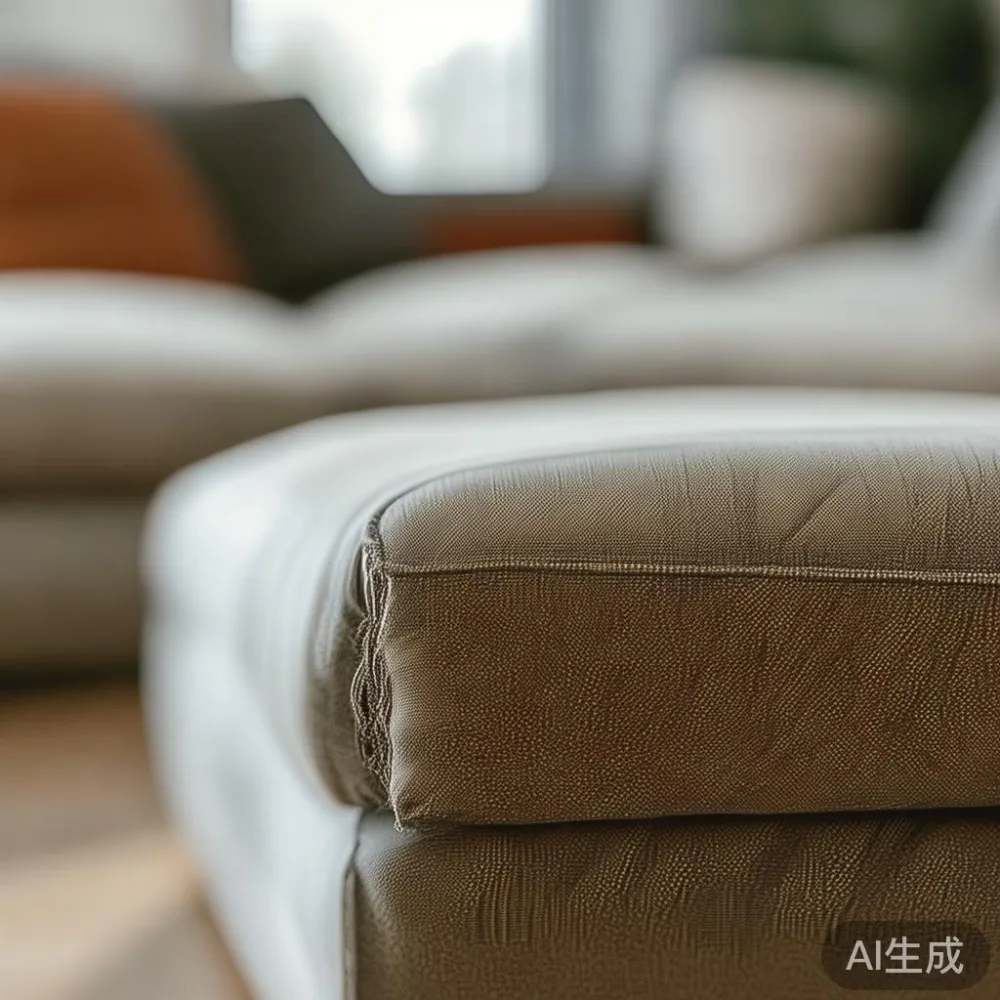
Assume a 3-seat fabric sofa measuring 210 cm wide, 88 cm deep and 82 cm high, with a total shipping weight of 68 kg. A veneer-frame version might cost SGD 1,680 before delivery, while a solid wood version might cost SGD 2,280. At SGD 35 per lift and SGD 45 for a second-person carry-up where required, delivery could add SGD 80 to SGD 140. This matters in older HDB blocks at Bedok or Tampines, where corridor widths can be about 90 cm and lift doors about 80 cm wide.
A light blue upholstery option should be checked under natural light, because a pale fabric shows dust and colour transfer more readily. Allow SGD 120 for professional cleaning in year 3 and SGD 60 for replacement cushion covers in year 5. A five-year solid wood total might therefore be SGD 2,280 + SGD 110 delivery + SGD 120 cleaning + SGD 80 refinishing = SGD 2,590. The comparable veneer total might be SGD 1,680 + SGD 110 + SGD 120 + SGD 40 board replacement = SGD 1,950. The initial saving is SGD 600, but solid wood can retain value better if its finish is maintained.

Owners should also measure the lift lobby, turning radius and bedroom door before ordering. A 210 cm sofa may travel diagonally through an 80 cm lift opening, but the calculation depends on the packed shape. MIDHILL can confirm packed dimensions before delivery, reducing the risk of a failed delivery day in a compact Singapore home.
How should veneer and solid wood be priced over 5 years?
The comparison below uses straightforward category averages rather than promotional allowances. Prices include normal Singapore GST. For a 180 cm by 90 cm dining table, a 120 cm wardrobe, a 45 cm nightstand and a 160 cm bed frame, the estimated results are:
3-seat fabric sofa, 210 cm: veneer frame SGD 1,680; solid wood frame SGD 2,280. Over 5 years, estimated ownership costs are SGD 1,950 and SGD 2,590 respectively.
Dining table, 180 cm × 90 cm: veneer on engineered board SGD 1,180; solid wood SGD 2,150. A veneer table may need edge banding replacement in year 4, costing around SGD 150. Solid wood may require a full refinishing in year 4 for SGD 280. Five-year totals are approximately SGD 1,480 and SGD 2,610.
Wardrobe, 120 cm: veneer carcass SGD 980; solid wood frame and panels SGD 1,680. Hardware adjustment is estimated at SGD 90 in year 3. A solid wood wardrobe may need refinishing around SGD 220. Total costs are SGD 1,190 and SGD 2,090.
Nightstand, 45 cm: veneer SGD 260; solid wood SGD 520. Repair and refinishing estimates bring the five-year totals to SGD 310 and SGD 600.
Bed frame, 160 cm: veneer with slats SGD 680; solid wood with slats SGD 1,120. A set of 13 hardwood slats may support the mattress, but centre support is useful. Refinishing or replacement expenses are estimated at SGD 120 and SGD 220. Total costs are SGD 940 and SGD 1,560.
Combined, the sample furniture set costs about SGD 4,780 for veneer and SGD 8,080 for solid wood over 5 years. The difference is SGD 3,300 before resale value. If the solid wood set later sells for 30% more and the veneer set for 10% more, the net gap falls by roughly SGD 1,392, assuming resale proceeds of SGD 2,644 and SGD 712. That still leaves a five-year difference of about SGD 1,908.
This is why material choice should be judged by use and repairability, not by a blanket rule. Veneer can be sensible for wardrobes and secondary tables. Solid wood often makes sense for a frequently handled bed frame, a dining table and a well-used fabric sofa frame.
What happens when veneer edges, joints and surfaces fail?
Veneer is a thin layer of timber, often 0.6 mm to 1.2 mm, bonded to engineered board or particleboard. Its surface can look convincing because the grain is real wood. The weak point is the edge and the underlying board. Water ingress can cause swelling, lifting or delamination, especially beside an open HDB window or in a humid bathroom-adjacent room.
Solid wood expands and contracts as humidity changes, but its thicker structure can usually be sanded and refinished. A dining table with a water ring may cost around SGD 40 to treat locally and SGD 280 for a full refinishing service. Veneer repair depends on the damage: a small edge chip might cost SGD 60, while a swollen panel can require SGD 150 to SGD 300 of board work.
Joint failure also differs. Dowelled or mortise-and-tenon joints in solid wood can sometimes be tightened for SGD 35 to SGD 90. Particleboard joints may need hardware replacement at SGD 70 to SGD 180. For the Japanese bed vs Nordic bed comparison, design and construction matter more than the national label: Japanese joinery and Nordic frames both work well when engineered for clearances and local use.
Solid wood is not automatically free from movement. A 180 cm dining top may move 3 mm to 6 mm across seasonal humidity changes. A quality maker should use appropriate joinery and finish layers. Buyers should ask about movement, moisture content and warranty exclusions rather than accepting “wood” as a sufficient specification.
Which material fits HDB flats and Singapore condos?
In a compact HDB flat, dimensions, weight and access can outweigh the timber debate. A slim 45 cm nightstand may fit a 90 cm bedside gap; a wide 120 cm wardrobe may be better in a walk-in area than beside a bedroom door. Solid wood furniture tends to weigh more, and a 160 cm bed frame might weigh 42 kg compared with 29 kg for a veneer frame. Two-person carrying may therefore cost an additional SGD 45 to SGD 90.
For a Punggol or Tampines condo, buyers may have wider corridors, often around 110 cm to 140 cm, and larger lifts, but access instructions should still be measured. Confirm the packaged width of the fabric sofa and whether the legs detach. A 210 cm sofa in two boxed sections is easier to move than one 205 cm rigid section.
Singapore’s 9% GST affects both material types, so it should not be treated as a reason to choose one over the other. Furniture delivered to a new condo may also incur access or assembly charges of SGD 80 to SGD 200. Under the free-shipping-over-US$350 threshold used by MIDHILL, eligible international orders can avoid separate freight charges, although Singapore delivery and GST still need confirmation at checkout.
A practical room-by-room approach is helpful. Use solid wood for the pieces that receive daily contact: a dining table, bed frame and solid wood fabric sofa. Veneer can work for a wardrobe or nightstand positioned away from moisture, provided edges are sealed and doors are fitted with adjustable hinges. A marble table is another category: a 100 cm square marble-top table might weigh 65 kg and cost SGD 1,980, with annual sealing estimated at SGD 90. Its five-year upkeep is closer to SGD 2,610, making the maintenance comparison broader than timber alone.
How do French and American light-luxury styles affect value?
Style affects what buyers keep and use. French light luxury often favours pale upholstery, refined profiles and visually calm furniture. A light blue luxury sofa in this setting can create an airy living room without requiring a large footprint. Allow 75 cm between the sofa and coffee table and 40 cm between the sofa and a walkway, where space permits.
American light luxury tends toward deeper comfort, larger dimensions and substantial-looking frames. A 220 cm fabric sofa with a solid wood frame may weigh 82 kg and cost SGD 2,680. Add SGD 140 delivery, SGD 160 for cleaning across years 2 and 4, and SGD 120 for refinishing, producing a five-year cost of SGD 3,100.
Post-modern light luxury uses cleaner lines and mixed materials. A European light luxury coffee table might combine a solid wood base with a marble or stone top at SGD 1,680, weighing 48 kg. Its five-year costs could reach SGD 2,050 after sealing and maintenance. The term for sale Post-modern furniture should describe clear design characteristics rather than a temporary sales trend.
Budgets often need several categories at once. For under 2000 Italian light luxury furniture, a buyer might focus on a dining table below SGD 2,000, but imported material, size and finish can move the price. The market description 2026 Italian light luxury furniture should be approached through construction details: timber species, joinery, finish, hardware and warranty—not origin alone.
What should you check before ordering furniture for 5 years?
Ask for a material breakdown. “Solid wood” should identify the species and whether it applies to the frame, legs, panels or only certain parts. For a MIDHILL bed, verify slat spacing, centre support, load expectations and joining methods. A dining table needs an extension method that does not weaken the top; a wardrobe needs adjustable hinges and moisture-resistant back panels.
Then check the finish. Matte, open-pore solid wood can show fingerprints and require more frequent care than a sealed surface. A satin finish may cost more initially but could reduce refinishing frequency. For upholstery, request fabric composition, removable-cover details and cleaning guidance. A fabric sofa should be tested with the actual fabric because durability ratings can differ between weave and fill.
Delivery planning deserves equal attention. Provide lift dimensions, corridor widths, door widths, parking distance and the number of flights. Ask whether assembly is included. A bed frame that takes 35 minutes to assemble may require a second person, while a nightstand may take 10 minutes with one. Confirm the delivery window in days as well as the installation date; production and consolidation can affect timing.
Is veneer or solid wood the smarter 5-year choice?
For the sample living and dining set, veneer costs about SGD 4,780 over 5 years, while solid wood costs about SGD 8,080 before resale value. Solid wood requires a higher first payment but offers repair and refinishing options that veneer cannot fully match. Veneer can deliver the lower purchase and maintenance burden where furniture is used gently and protected from moisture.
The practical answer depends on the product. Choose a solid wood bed frame, dining table and fabric sofa frame for frequent use, especially in homes where pieces may be refinished rather than discarded. Choose veneer for a wardrobe or nightstand when savings matter and the unit can be replaced within 5 years.
Do not forget return rights. MIDHILL offers a 14-day return period, subject to its conditions, which can reduce the risk of an unsuitable fabric sofa or a dining table that does not fit the corridor. For long-term value, request the exact timber, finish and construction specifications, calculate the five-year maintenance allowance, and compare the total ownership cost rather than the ticket price.