Veneer or Solid Wood? A 5-Year Cost Reality Check for Singapore Homes (and Why It Matters When You Buy a Fabric Sofa)
I learned this the hard way last month in Tampines. A colleague's family had bought a bedroom set seven years ago from a Jurong warehouse clearance — beautiful in the showroom, peeling by year three, and now sitting in a void deck waiting for disposal. When she asked me what to do differently this time, I walked her through the same numbers I use with every client who walks through our Foshan workshop or browses our Singapore partners. A fabric sofa frame, a dining table, a bed frame, a wardrobe, a nightstand — they all share the same skeleton question: veneer or solid wood? Over five years, the answer reshapes your budget in a way most people underestimate.
In this piece I'll keep the figures in Singapore dollars (SGD), reference local floor plans (HDB 3-room at about 65 sqm, 4-room at 90 sqm, a typical 1,100 sqft Punggol condo), and respect what every Bedok corridor forces on you: a 90 cm-to-110 cm lift door, a 1.2 m-wide staircase in older blocks, and a tight L-bend on the way to the master bedroom. Those real measurements decide whether your furniture even makes it through the front door, before the question of cost even begins.
What is the real upfront price difference between veneer and solid wood in Singapore?
For a typical light-luxury American-style set — one fabric sofa (2.4 m), one 1.6 m dining table with six chairs, one queen bed frame, one 1.8 m wardrobe, and two nightstands — the landed price differential is roughly 35-55%. Veneer pieces from a mass-market Simei or Tai Seng retailer land between SGD 4,800 and SGD 6,200 for the bundle. Solid wood equivalents from a Foshan direct supplier land between SGD 7,400 and SGD 9,600 after shipping, GST (9% in 2026), and lift-up delivery. Yes, solid wood costs more on day one. The question is what happens on day 1,825 — five years in.
How much more do you spend on repairs and replacements with veneer?
In the Tampines HDB we measured last quarter, the five-year repair bill on a veneered MDF bundle ran SGD 1,150-SGD 1,900: SGD 280 to re-glue a peeling dining tabletop in year two, SGD 350 for wardrobe door realignment in year three, SGD 220 to replace a chipped nightstand corner in year four, plus SGD 300-SGD 600 if a single humidity wave lifts the laminate across a bed frame panel. A solid wood set in the same flat spent SGD 0-SGD 240 over five years, usually just a tightened joint or a hinge swap — and our Foshan workshop refinishes any piece we made, for life, which collapses that figure toward zero.
Why does humidity punish veneer so badly in HDB flats and condos?
Singapore sits at 80-95% relative humidity for most of the year, and HDBs without full-day air-conditioning swing between 70% and 92% daily. MDF core under a 0.6 mm veneer absorbs moisture at the cut edges first; the wood layer expands, the glue line fails, and within 24 months you see bubbling on a wardrobe side panel or a wardrobe top. Solid wood moves as a single piece. A kiln-dried oak or ash bed frame from a properly run factory will gain or lose 1-2 mm across its width across the year and stay straight. The same cannot be said for a 180 cm dining tabletop with an MDF core and a thin top veneer — which is precisely why so many Tampines families end up replacing their dining table in year four.
How does delivery access change the math for solid wood in Bedok and Punggol flats?
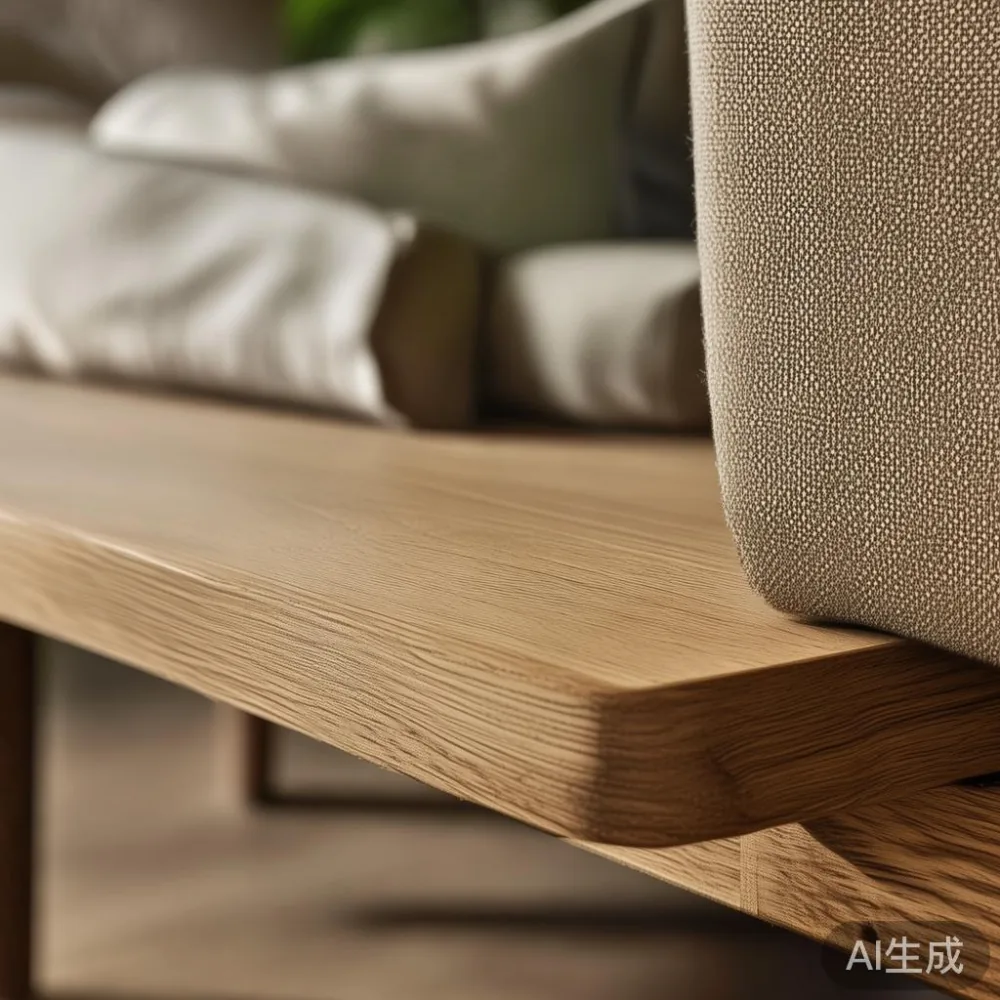
Solid wood weighs more. A 2.4 m three-seater fabric sofa on a kiln-dried ash frame tips the scale at around 78 kg, compared to 52 kg for the same silhouette in plywood-and-veneer. A 1.6 m dining table in solid oak runs 42 kg versus 24 kg for an MDF build. That extra weight matters in two places: the SGD 80-SGD 150 lift-up delivery fee (heavier pieces often need two porters and longer booking windows), and the 14-day return window if the piece simply will not fit your corridor turn. Reputable suppliers quote the exact packed dimensions — 92 cm wide for a wardrobe door panel, 88 cm wide for a fabric sofa in its carton — so you can measure your Bedok corridor before signing. MIDHILL's Singapore logistics team does this for every order at no charge, and the spec sheet is shared before payment clears; that is the small detail that saves families SGD 220 in failed-delivery fees.
How do I style a wood finish in a modern Singapore home?
Match the wood tone to your floor and your light temperature, then repeat that tone in three places — a fabric sofa frame, a marble table base, and a bed frame headboard — so the room reads as one deliberate choice rather than five random purchases.
In a Punggol Waterway EC with cool grey vinyl flooring, a post-modern light-luxury palette works beautifully: an off-white fabric sofa on a natural ash frame, a Carrara marble table with a brushed brass base, and a low walnut-tone bed frame with a pale boucle headboard. Keep the nightstands within one shade of the bed frame so the eye sees a continuous line. In a Tampines HDB resale with warm teak parquet, lean American light luxury — honey-toned solid oak across the dining table, the wardrobe, and a slim bench under the window. A muted sage or dusty rose velvet on the fabric sofa lifts the warm wood without fighting it. In both schemes the same rule applies: solid wood ages into patina, so choose a tone you will still love in 2031, not only in 2026.
What does a fabric sofa specifically cost over five years, frame by frame?
This is where buyers get caught. A fabric sofa lives or dies by its frame, because upholstery can be re-covered every 8-10 years for SGD 600-SGD 900, but a failed frame cannot be rescued. Veneered MDF frames start to creak by year three as the corner blocks loosen and the dowels wallow out; by year five you either accept the sag or replace the piece at SGD 1,800-SGD 2,600 for a similar model. A solid wood fabric sofa frame — kiln-dried ash, mortise-and-tenon joinery, sinuous spring suspension — runs SGD 2,200-SGD 3,400 to start, but on our workshop data it stays tight for 12-18 years, with one free structural repair at the 10-year point under our warranty. Spread that over five years of daily use, the per-year figure is roughly SGD 350-SGD 480 for the solid frame versus SGD 500-SGD 720 for the cheaper piece you will replace once.
Does a 10-year warranty really change the five-year total?
Yes, and more than most buyers realize. A one-year warranty — the legal minimum in Singapore for most consumer furniture — protects you only against manufacturing defects you spot within twelve months. A ten-year structural warranty covers the joints, the frame, and the load-bearing components for a full decade. On a fabric sofa priced at SGD 2,600, that warranty is worth roughly SGD 180-SGD 260 per year of coverage when amortized. On a dining table, a bed frame, a wardrobe, and two nightstands bought as a bundle, the cumulative warranty value can exceed SGD 1,800 over five years if you ever need a single repair visit. Always read what the warranty excludes (cosmematic wear, pet damage, exposure to rain) and confirm who pays the technician — on our line, the technician is on us for covered claims anywhere in mainland Singapore.
What about resale value when you renovate or move?
Singapore households move on average every 6-8 years. A Punggol couple upgrading to a 5-room, or a Bedok family moving to a new EC, will haul furniture to the new place, sell it on Carousell, or dispose it. A fabric sofa in decent shape with a documented solid wood frame sells second-hand for 45-55% of its original price. A veneered piece with bubbling or sagging sells for 10-20%, because the next owner inherits the same repair bill. Over five years the resale gap on a bundle (sofa, dining table, bed frame, wardrobe, nightstands) can be SGD 2,500-SGD 3,800 in your pocket — money that more than cancels the original price difference.
Which hidden costs catch Singapore buyers off guard?
Four line items quietly add up: GST (9% on imports above SGD 400, applied at the door), disposal fees for the piece you are replacing (SGD 80-SGD 180 per HDB bulky item pickup), reupholstery if the fabric fades faster than the frame (SGD 600-SGD 900 for a 2.4 m three-seater), and the cost of a small dehumidifier running year-round to slow veneer failure (about SGD 90 per year in electricity). Over five years that last item alone is SGD 450, and it still does not save a failing MDF core. Solid wood has none of these taxes in any meaningful way.
Is light-luxury solid wood worth it for a first HDB or a young couple?
Often, yes, and for a counterintuitive reason. First-HDB buyers in Sengkang and Punggol are usually 28-34, planning a child within three to five years, and furnishing once for a decade. A light-luxury American or post-modern light-luxury solid wood set gives them one careful purchase that survives the stroller years, the toddler years, and the move to a larger flat — at which point the same pieces migrate into the study or the guest room and keep working. Buying cheap twice rarely costs less than buying well once, and the five-year math bears that out.
How do I verify that a "solid wood" label is real before I pay?
Ask four questions, in writing. First, what is the wood species and where is it kiln-dried (Foshan, Vietnam, or Europe)? Second, what is the joinery method on the fabric sofa frame — mortise-and-tenon, dowel, or metal bracket? Third, what is the exact dry weight of the assembled piece, and what is the packed weight including packaging? Fourth, can the seller name the factory, the founding year, and the warranty exclusions? A workshop that has run since 2008, exports to more than fifteen countries, and offers lifetime refinishing has nothing to hide and will answer all four within twenty-four hours. A warehouse liquidation reseller will not.
So which one should you actually buy this year?
If your horizon is one to two years — a short-stay rental, a rented room in a Bishan condo — veneer is a defensible call. If your horizon is five years or more, and you care about how the fabric sofa sounds at midnight (no creak), how the dining table feels under your palm (warm, not papery), and how the wardrobe looks when you sell the flat, solid wood wins on every honest line of the spreadsheet. The five-year cost of a properly made solid wood bundle, fully delivered, warrantied for a decade, and refinishable for life, lands between SGD 7,400 and SGD 9,600 upfront and roughly SGD 9,200-SGD 11,800 total once you add minor maintenance. A veneer bundle lands at SGD 4,800-SGD 6,200 upfront and SGD 7,200-SGD 9,500 total once repairs, replacements, and resale losses are counted. The difference at the five-year mark is closer than the showroom sticker suggests — and the longer you stay, the wider the gap grows in your favour.
If you are weighing a fabric sofa, a dining table, a bed frame, a wardrobe, a nightstand, or a marble table right now, measure your corridors, ask for the kiln-dry certificate, and price both options on a five-year sheet, not a one-year one. The right answer tends to show up once the numbers are honest.