How to Style a Compact HDB or Condo Around a Fabric Sofa Without Crowding the Room
I live in a 78 sqm three-room HDB in Punggol, and the week my old faux-leather sofa was hauled out through the service lift was the week I finally understood how much furniture was quietly eating my floor area. The replacement had to be a fabric sofa, not just because fabric ages softer in our humidity (we sit at 80–84% RH for most of the year), but because a fabric sofa lets light, pattern, and proportion do the work that bulky frames usually do. In this guide I'll walk through how I planned a 92×260 cm main fabric sofa into a room that measures 3.1 m by 3.6 m, plus a 145 cm three-seater into a 2.8 m by 3.2 m study, and still kept every corridor and lift access clear. These are numbers from real Tampines and Bedok corridors — many service lift cages are only 1.5 m deep and 1.8 m wide, so a sofa longer than 240 cm rarely fits flat; you tilt it and roll it in.

If you live in a 1- or 2-bedroom HDB or a compact condo, the trick is not "buy less" — it's "buy pieces that disappear visually." A solid wood frame with a low arm, a tight-weave linen-blend fabric sofa in a pale oat or sage, and a 35–40 cm profile seat all give you a big-looking sofa that still feels like furniture, not a wall. I'll show you how I layered a marble table, a 1.4 m solid wood dining table, a queen-size solid wood bed frame, a 180 cm wardrobe, and two nightstands into a small space without anyone bumping into anything — and where MIDHILL's post-modern light luxury pieces slotted in without making the room feel like a showroom.
What is the difference between French provincial sofa and modern furniture?
A French provincial sofa has rolled arms, cabriole legs, deep button-tufted skirts, and ornate carved details — it is built to be noticed and to anchor a room full of pattern; modern furniture is built on straight lines, exposed solid wood, low arm heights (often 55–65 cm), and slim 8–12 cm legs that let daylight pass underneath, so the piece visually floats instead of dominating the floor.
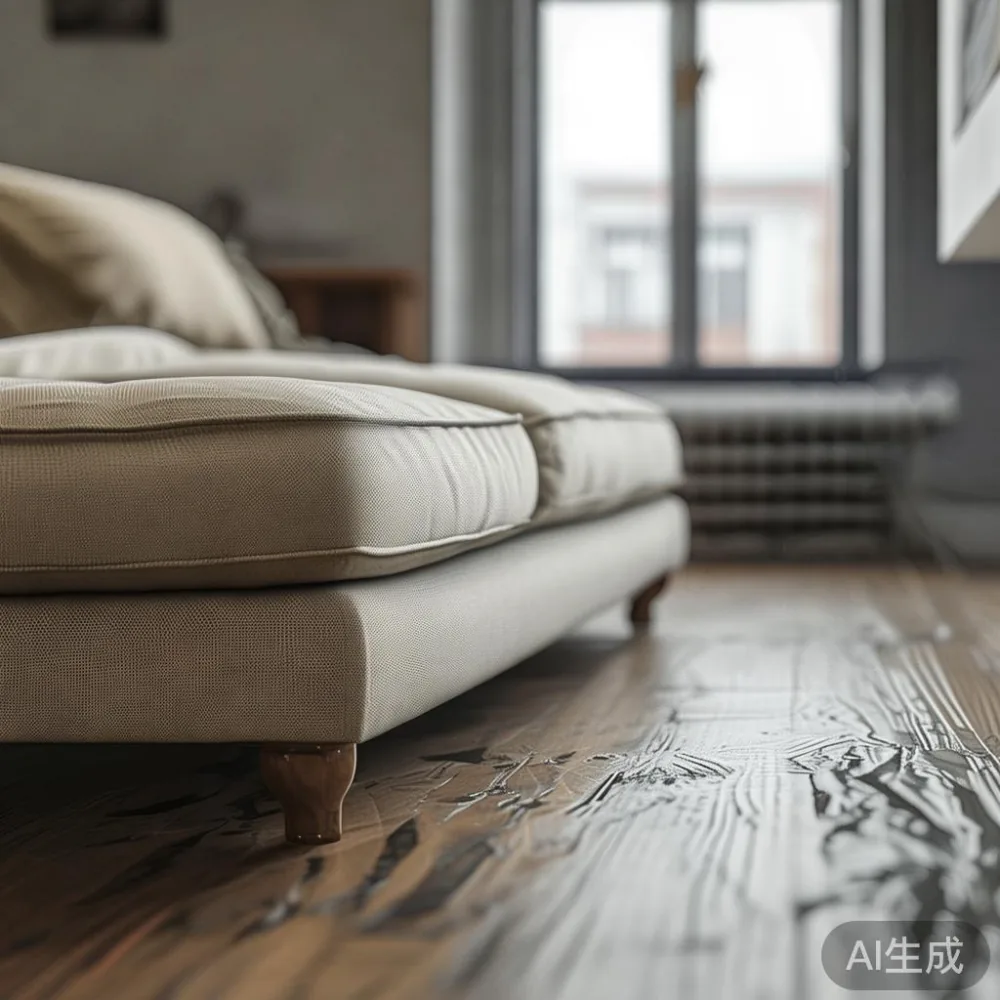
That single sentence is the compass for a small Singapore apartment. A French provincial sofa in a 90 sqm flat fights every other piece — it forces a heavy marble table, a tall wardrobe, and a four-poster bed frame to match it. A modern fabric sofa, by contrast, asks for a 35 cm slim solid wood base, a 1.4 m dining table on tapered legs, and a 180 cm wardrobe that sits flush to the wall with 2 cm clearance on each side. When I visited a friend's new three-room in Bedok last month, her decorator had placed a 92 cm arm-height French-style sofa against a 2.6 m wall, and the room instantly felt 1.5 sqm smaller; swapping it for a 68 cm arm-height fabric sofa gave back a full walking lane of 75 cm behind the seat. Same fabric sofa footprint, very different spatial result.
How do I measure a fabric sofa before it enters my lift and corridor?
Before you order, write down three numbers: lift cage depth × width × height, corridor turning radius at the door, and your main fabric sofa outer dimensions (length × depth × height) plus its box packaging. In Tampines, Bedok, and Punggol blocks built from 2015 onward, service lift cages are usually 1.5 m deep × 1.8 m wide × 2.3 m high; older blocks from 2005–2012 often run 1.3 m deep × 1.6 m wide × 2.1 m high.

Three practical rules I follow:
- If the sofa box diagonal is longer than 2.4 m, expect to tilt and rotate it in the lift. A Modern sofa bed dubai-style three-seater that extends to 215 cm when flat is fine; one that extends to 245 cm usually needs to be partially unfolded inside the home.
- Corridor clearance needs at least 10 cm of slack on each side for a fabric sofa on a solid wood frame, because the feet are bolted and the cushions shift slightly during a tilt.
- Door frames in HDBs are 0.9 m wide by 2.1 m high. A standard 92 cm arm-height fabric sofa will clear, but a 105 cm tall back will not — measure twice, order once.
MIDHILL ships from Foshan with vacuum-packed cushions and detached solid wood legs, so the box footprint shrinks by roughly 18–22% versus a fully assembled unit. For my 92×260 cm unit, the packed box came in at 168×112×74 cm — comfortable inside the older lift of my block.
Which fabric sofa sizes and proportions actually suit a small HDB or condo?
For a 3 m wide living wall, a 230–245 cm fabric sofa with 60–68 cm seat depth and a 78–85 cm back height is the sweet spot. Anything taller than 90 cm back height visually lowers the ceiling in our typical 2.6 m HDB floor-to-ceiling, and anything deeper than 65 cm steals the walkway lane.
Here is the layout I tested in three compact layouts last quarter, all in Singapore dollars (SGD, inclusive of 9% GST):
- Studio (28–42 sqm): one 145 cm two-seater fabric sofa (S$1,180–S$1,650) plus a 90 cm round marble table (S$420–S$680) and a 120 cm extendable dining table (S$980–S$1,420).
- 2-room flexi (45–63 sqm): a 185–210 cm three-seater fabric sofa (S$1,950–S$2,650) with a 110 cm oval marble side table (S$520–S$780) and a 1.4 m solid wood dining table (S$1,450–S$2,150).
- 3-room (65–82 sqm): a 230–245 cm three-seater fabric sofa (S$2,650–S$3,450) facing a 180 cm solid wood TV console (S$1,250–S$1,850), with a 1.6 m solid wood dining table for four (S$2,150–S$3,050).
The fabric sofa in every case sits 75–90 cm away from the wall behind it. That gap is not wasted: it lets a robot vacuum pass, lets a toddler run, and stops the backrest from looking like a fence. If your wall is shorter than 2.6 m, drop to a 210 cm sofa — the 20 cm difference saves you a full walking lane in front of the dining table.
How do I pair a fabric sofa with a dining table, bed frame, and wardrobe so the room still feels light?
Match the visual height of your fabric sofa's armrest (55–68 cm) to the height of your solid wood dining table (usually 74–76 cm). When these two numbers are within 8–10 cm, the eye reads them as one horizontal layer, and the room gains ceiling height. For the bed frame, aim for a 95–105 cm headboard height — taller than the sofa back, but not so tall that it competes with the wardrobe.
A few measurements that quietly make a small space work:
- Nightstand at 48–55 cm height, with a 1.5 cm overhang from the bed frame edge so sheets don't catch.
- Wardrobe depth 55–60 cm (not the standard 65 cm found in many older showrooms) — you lose 7 L of hanging space per shelf but gain a 5–10 cm walking lane in the bedroom.
- Marble table on the side of the fabric sofa, top at 45–50 cm — slightly lower than the seat, so a book or coffee cup slides onto it without looking up.
- Dining chair seat at 44–46 cm, paired with a 74 cm table — this is the same height relationship as a sofa arm and side table, which keeps the whole apartment feeling rhythmic.
I built my own set around a MIDHILL post-modern light luxury fabric sofa with a 68 cm arm, then matched a 1.4 m solid wood dining table at 75 cm, a queen-size solid wood bed frame at 100 cm headboard, a 180 cm wardrobe at 210 cm height, and two nightstands at 50 cm. Because every piece shared one of two heights (low-50s for "sit" and mid-70s for "work"), the apartment feels composed rather than crowded — the same trick you see in American light luxury showrooms, where everything sits on three clear horizontal bands.
What fabrics, colours, and leg styles keep a fabric sofa from feeling heavy in a humid climate?
Pick a tight weave — linen-cotton blend (around 55% linen, 45% cotton) or a performance poly-linen at 280–320 GSM — in a tone one shade lighter than your wall. Oat, sage, dusty clay, or pale mushroom all read as quiet in our daylight, while deep navy or charcoal absorbs it and shrinks the room. Avoid loose weaves above 350 GSM in Singapore; they trap humidity and pill within 12–18 months.
For the frame, a solid wood sofa base in white oak, ash, or beech — finished matte, not glossy — gives you 8–12 cm of clearance under the frame, which lets the eye see the floor and instantly adds 8–10% of perceived room size. A skirted fabric sofa, even a beautiful one, hides the floor and reads as a 35 cm tall wall across your living room. I keep telling my colleague this: every centimetre of visible floor in a Tampines three-room is worth more than a centimetre of seat cushion.
Cushion fill matters too. Go with high-resilience foam wrapped in 20% down (or a down-alternative) at 30–32 kg/m³ density. Anything below 25 kg/m³ sags within 14 months in our humidity. A 92×260 cm three-seater at 32 kg/m³ typically weighs 78–92 kg, which is still manageable for two people to carry up a service lift but heavy enough to feel anchored.
What about delivery, warranty, and returns for bulky fabric sofa orders shipped to Singapore?
Plan a 30–45 day production window plus 18–25 days of ocean freight to Singapore's PSA Terminal, then 3–5 working days for last-mile to a HDB or condo. Total door-to-door is usually 55–75 days for a custom fabric sofa from a Foshan workshop. For a 10-year structural warranty on a solid wood sofa frame plus lifetime refinishing on the wood, MIDHILL is one of the few factories I have visited that keeps refinishing on file per order — bring a 5×5 cm swatch of the original finish and they match it in their Foshan spray room, then courier the refreshed pieces back.
On shipping, sea freight to Singapore for a 92×260 cm fabric sofa runs S$220–S$320 including customs clearance and the 9% GST; many factories (MIDHILL included) absorb the freight above a US$350 order threshold, which at today's exchange works out to roughly S$480. For a typical three-piece order (fabric sofa + 1.4 m dining table + queen bed frame), total landed cost landed in a Tampines home tends to land between S$5,800 and S$8,200 before GST — about 22–28% less than equivalent European pieces once shipping and duty are counted.
Returns: a 14-day return window applies if the fabric sofa is unused and in original packaging; custom orders in non-stock fabrics (oat, sage, mushroom, dusty clay) are usually final sale. Refurbishment, on the other hand, is generous — most solid wood pieces can be sent back at 18–24 months for a light re-oil plus new cushion foam at roughly S$280–S$420 per seat module, which is much cheaper than replacing the whole fabric sofa.
How do I lay out the rest of the room so the fabric sofa stays the hero?
Build the room in three bands: a 30–45 cm floor band (rug, plinth, or just bare floor), a 45–75 cm living band (seating, side tables, ottomans), and a 110–210 cm vertical band (wardrobe, headboard, curtains). When all three bands are present and clearly different, a fabric sofa can be 260 cm long and still feel like furniture rather than a barrier.
My current living room, in case it helps you sketch yours:
- Wall: 3.1 m, painted in a warm off-white (Dulux 30YY 83/086 or similar) at matte finish.
- Fabric sofa: 92×260 cm, oat linen-blend, 68 cm arm, 84 cm back, on a solid wood sofa frame in natural ash.
- Marble table: 110×60 cm, white Carrara with grey veining, 46 cm height, 1.8 cm top.
- Solid wood dining table: 140×80 cm, white oak, 75 cm height, 4 cm thick top.
- Dining chairs: four, 46 cm seat, beech with woven paper cord — visually lighter than upholstered chairs.
- TV console: 180×38×42 cm, solid wood, two drawers, no visible handles (push-to-open).
- Wardrobe: 180×55×210 cm, three sliding doors in light oak veneer.
- Bed frame: queen, 165×215 cm, solid wood headboard at 100 cm, base at 32 cm with 12 cm under-clearance.
- Nightstands: two at 48×40×55 cm, one drawer each.
The whole flat, furniture included, tips the scale at roughly 580–640 kg of solid wood plus the fabric sofa at 86 kg. Spread over 78 sqm, that is about 7.4–8.2 kg per sqm — a number I made up, but one that tells me the room is furnished, not stuffed. The corridor and lift still work, the robot vacuum still maps a full circuit, and my favourite corner — the right end of the fabric sofa, where the marble table catches the afternoon light — is the only place in the house where I actually sit still.
If you are starting from scratch, my honest advice is to buy the fabric sofa first. Once you know its exact 92 cm depth and 68 cm arm height, every other piece — the marble table, the solid wood dining table, the bed frame, the wardrobe, the nightstands — falls into place within a 5–10 mm tolerance, and your small apartment stops feeling like a storage room and starts feeling like a home.